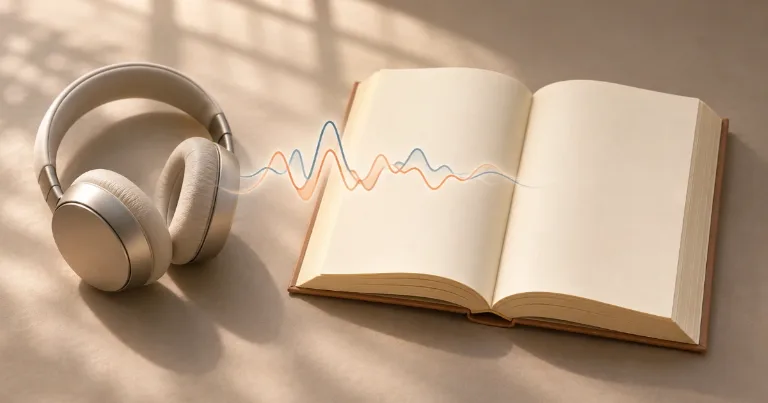

I've experienced that strange moment when an audiobook says something different from the book I'm reading. The story is the same, the characters are the same, but the words aren't. For a moment, I wondered if I had bought the wrong edition.
Apparently, this can happen for several reasons, and it doesn't always mean there's something wrong with your audiobook.
Some books have different translations, while others have been revised since they were first published. There are also audiobooks that leave out parts of the original story. So even if both copies have the same title and author, they might not use exactly the same text.
Why the Words Are Different
One interesting example is The Metamorphosis by Franz Kafka. It's a story about Gregor Samsa, a traveling salesman who wakes up one morning and discovers that he's turned into a strange creature.
The book was originally written in German, and there are several English translations.
In the free ebook translated by David Wyllie, Gregor wakes from "troubled dreams."
But in Ian Johnston's translation, those words become "anxious dreams."
You can actually compare them yourself. LibriVox has a free audiobook narrated by David Barnes using Johnston's translation.
Imagine following Wyllie's ebook while listening to that recording. You haven't even finished the first sentence, and the words are already different.
Neither version is necessarily wrong. Translators make their own choices when turning a story from one language into another. Sometimes one word can express the same idea in a slightly different way.
But translations aren't the only reason this happens.
Alice Oseman, the author of Solitaire and creator of Heartstopper, made editorial changes to Solitaire in August 2020. She confirmed this on her official website, explaining that the edited edition includes an author's note.
This means older and newer copies of the same novel can contain different wording. If an audiobook was recorded using one version and you're reading another, you could notice those differences.
There are a few other possibilities:
Abridged audiobooks: These are shortened versions of books. Some descriptions, conversations, or entire scenes may be removed.
Dramatized adaptations: These can change how a story is presented, using actors, sound effects, and sometimes rewritten dialogue.
Narration mistakes: A narrator might accidentally skip a word, change a phrase, or miss a sentence.
Even an unabridged audiobook isn't guaranteed to match your particular paperback or ebook. It simply means the recording hasn't been intentionally shortened from the version used to produce it.
How to Check Before Buying an Audiobook
If you enjoy listening while following the words on a page, I'd recommend checking a few things before purchasing.
Start with the audiobook sample. Play the opening of the story while looking at your physical book or ebook preview. If the sentences already sound different, check the edition details.
Look for the translator's name, especially when buying classic literature. The same novel can have several English translations, and the cover doesn't always make that obvious.
You should also compare the publisher, publication year, and any notes about revised editions. Different formats usually have different ISBNs, so you're looking for matching versions rather than identical numbers.
And don't forget to check whether the audiobook is labeled unabridged, abridged, or dramatized. Those descriptions can save you from buying something different from what you expected.
If you already own both versions, try comparing another passage before deciding something is wrong. If the wording changes throughout, you're probably dealing with a different translation or edition. If only one sentence is missing, it could simply be a recording mistake.
For anyone who regularly combines reading and listening, this is worth knowing. Audiobooks are one of the ways people manage to finish more books, something I also explored in How People Really Read 300 Books a Year.
Personally, I don't mind different versions of a story. Sometimes it's interesting to see how another translator expresses the same scene. But when I'm reading and listening at the same time, I prefer the words to match.
Otherwise, I end up paying more attention to finding the missing sentence than enjoying the actual book.