

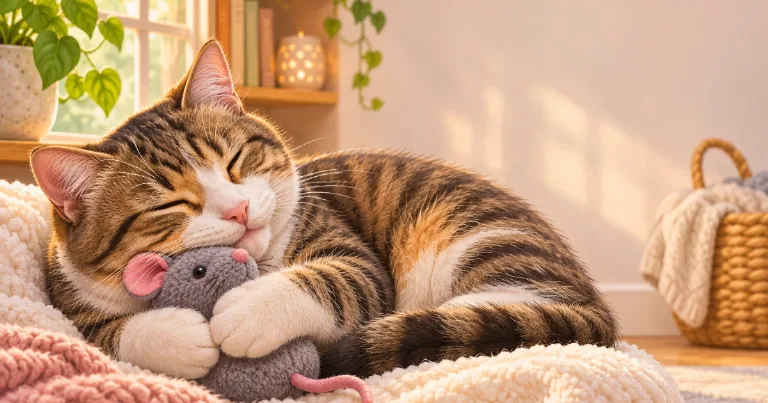

I have a cat who gets attached to toys, and I've always found it interesting how cats develop such specific preferences. You can buy them something new, but that doesn't necessarily mean they'll like it more than the old one.
It made me wonder why some cats become so attached to a particular toy, sometimes carrying it around, sleeping beside it, or repeatedly choosing it over everything else.
Their preferences may have more to do with hunting instincts, familiar scents, and enjoyable experiences than we realize.
Why Do Cats Have a Favorite Toy?
Cats are natural hunters, even when they've spent their entire lives indoors. Playing allows them to practice behaviors such as stalking, chasing, grabbing, and biting.
Some toys are simply better suited to these instincts. A small stuffed mouse might be easy to carry, while a feather toy might move in a way that catches their attention.
Texture, size, sound, and movement can all influence what a cat enjoys playing with. Something that fascinates one cat might completely bore another.
Familiarity may also play a role. Cats rely heavily on their sense of smell, and an old toy can carry recognizable scents from their surroundings.
Repeated play can also strengthen a cat's preference. If they consistently enjoy playing with a particular toy, they may become more likely to choose it again.
Why Won't Cats Always Accept a Replacement?
Here's something I find particularly interesting. You could buy an identical version of your cat's favorite toy, and there's still no guarantee they'll accept it.
Although two toys might look exactly the same to us, they may smell or feel different to a cat.
An older toy might have a familiar scent, a softer texture from repeated use, or a shape that has changed slightly over time. The replacement doesn't necessarily offer those same qualities.
That doesn't mean cats experience sentimental attachment exactly as humans do. Researchers haven't established that. But their individual preferences and ability to learn from positive experiences help explain why certain toys become favorites.
If your cat loses its favorite toy, try offering something with a similar texture, size, or movement. Give them time to become familiar with it rather than expecting an immediate replacement.
And if they still prefer their old, slightly worn-out toy, that's fine, provided it's safe and doesn't have loose pieces they could swallow.
I suppose that's another funny thing about having a cat. We can spend money choosing what we think they'll love, but ultimately, they're the ones making the decisions.