


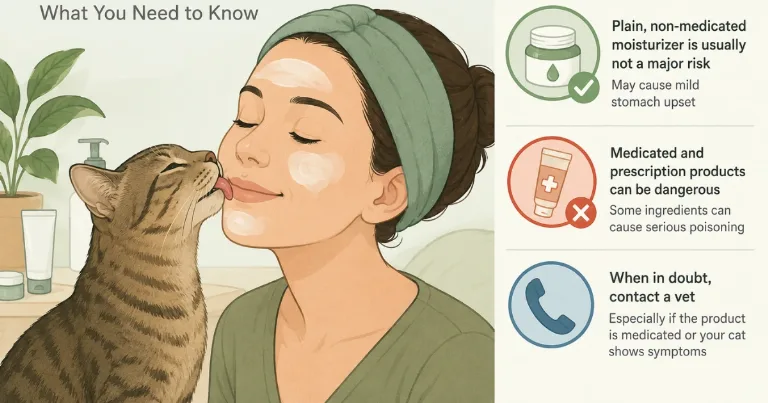

A cat licking your face can feel like part of a normal bedtime routine, especially when your cat likes to groom you while settling down. Once skincare is involved, it is better to redirect those kisses. A tiny lick of ordinary, non-medicated moisturizer will usually cause no more than mild stomach upset, but medicated creams and certain active ingredients can be far more dangerous.
The Product Matters More Than the Waiting Time
There is no single waiting period that makes every skincare product safe for a cat to lick.
Allowing a product to dry or absorb can reduce the amount sitting loosely on your skin, but it does not prove that no residue remains. Leave-on products are made to stay on the skin, and some may also transfer to hands, pillowcases, clothing, or a cat’s fur.
For a basic non-medicated lotion, one quick lick is unlikely to be an emergency. The ASPCA notes that a small ingestion of moisturizing lotion, including licking it from a person’s skin, will generally cause only mild stomach upset. A larger amount may lead to more vomiting or diarrhea. Oily products can also create an aspiration risk if the cat vomits and inhales some of the material.
That reassurance does not apply automatically to every serum, acne treatment, prescription cream, hair-growth product, or concentrated botanical oil. Human topical products can contain several active ingredients, sometimes at very different strengths. Veterinary guidance recommends checking the full product label rather than judging safety by whether the cream feels dry.
A practical habit is to keep your cat from licking any freshly treated area. Wash product from your hands before touching your cat, store tubes and applicators inside a closed cabinet, and prevent your cat from rubbing against your face until the product has settled.
Applying skincare earlier in the evening may help if your cat regularly sleeps beside your head. A clean pillowcase or a physical barrier can also reduce contact, but these steps should not be treated as permission to expose a cat to a hazardous medication.
Some Topical Products Need Stricter Separation
The greatest concern is not ordinary face cream. It is a medicated product that may cause serious poisoning from a small exposure.
One clear example is fluorouracil, also called 5-FU, a prescription topical medicine used for certain precancerous and cancerous skin conditions. Cats and dogs can become critically ill after licking treated skin, chewing the tube, or contacting contaminated material. The FDA warns that symptoms can begin within 30 minutes and may include vomiting, shaking, seizures, breathing difficulty, and diarrhea. Death can occur within 6 to 12 hours.
Minoxidil, which is used for hair loss, also presents a serious risk. Cats are particularly sensitive, and even small exposures may cause life-threatening heart and breathing problems. The ASPCA advises preventing pets from licking or touching treated skin. Cats should also be kept away from pillows, bedding, clothing, or furniture that may carry minoxidil residue.
Other topical medicines may also require caution. These include pain-relief creams containing nonsteroidal anti-inflammatory drugs, prescription psoriasis products such as calcipotriene, products containing lidocaine or other numbing medicines, concentrated essential oils, zinc oxide creams, and compounded creams containing several medications.
Cats can be especially vulnerable to topical pain medicines. Exposure may happen when a cat licks the medication from someone’s skin or grooms its coat after rubbing against a treated area. Possible effects include digestive irritation, stomach ulcers, kidney injury, and neurological symptoms, depending on the drug and the amount.
Essential oils also deserve caution. The risk varies according to the specific oil, its concentration, and how much the cat contacts or swallows. Concentrated oils can cause digestive, neurological, or liver problems in cats, so a product described as natural should not automatically be considered pet-safe.
This does not mean that every familiar skincare ingredient will poison a cat after one brief lick. It means owners should avoid broad claims that all skincare is toxic or that every product is safe once absorbed. The ingredients, concentration, amount transferred, and the cat’s condition all matter.
What to Do After Your Cat Licks Skincare
First, stop your cat from licking your face again and find the product container. Check whether it is a basic cosmetic, an over-the-counter treatment, or a prescription medication.
For a single lick of plain, non-medicated moisturizer, observe your cat for drooling, vomiting, diarrhea, unusual tiredness, or loss of appetite. Mild stomach upset may be the only effect, but advice should still be based on the actual ingredient list.
Contact a veterinarian or animal poison service promptly when the product is medicated or you cannot identify its ingredients. You should also seek help when it contains fluorouracil, minoxidil, a pain medicine, or concentrated essential oils.
Veterinary advice is also important if your cat licked the product repeatedly, swallowed some from the tube, or got it on the coat or paws. Symptoms such as vomiting, tremors, weakness, breathing trouble, seizures, or unusual behavior require urgent attention.
Do not try to make your cat vomit unless a veterinarian specifically tells you to. Bring or photograph the packaging so the veterinary team can see the ingredients, concentration, and product size. The amount involved, the route of exposure, and your cat’s weight can all affect the advice.
In the United States, the ASPCA Animal Poison Control Center is available at 888-426-4435. A consultation fee may apply. Pet Poison Helpline can be reached at 855-764-7661. You may also call your regular veterinarian or the nearest emergency veterinary clinic.
A safer routine is to enjoy your cat’s affection before applying leave-on products, then gently redirect face licking after your skincare routine. Ordinary moisturizer and dangerous prescription cream do not carry the same level of risk, but your cat cannot tell the difference by smell or taste.