


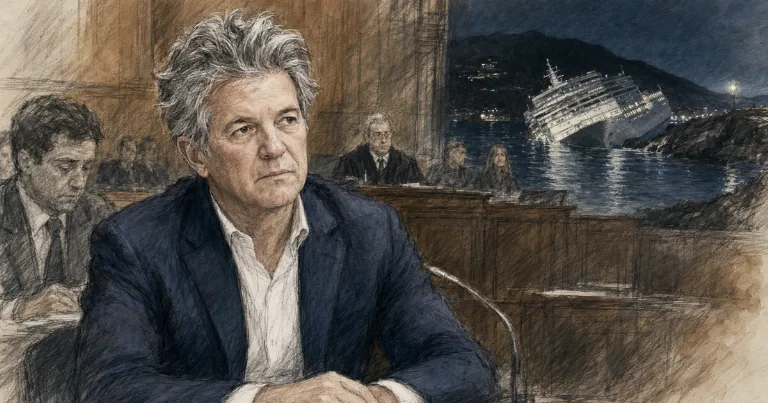

I just finished watching Netflix’s Shipwrecked: Nightmare at Sea, and Manrico Giampedroni’s final update felt too short. The documentary shows him helping passengers, getting trapped inside the Costa Concordia and surviving with a broken leg. It then says he received a two-and-a-half-year sentence.
The missing detail is that Giampedroni was held responsible for failures in his evacuation duties before his later rescue work. He did not cause the ship to hit the rocks, and his sentence did not erase the people he helped.
Why Giampedroni Received a Prison Sentence
Giampedroni was the hotel director on the Costa Concordia. That role included more than managing cabins, restaurants and guest services. During an emergency, he was responsible for helping move passengers from their cabins to the muster stations, where they could be sent to the lifeboats.
He also had to report evacuation readiness to the bridge. In later court testimony, Giampedroni said he radioed that the cabins had been evacuated but received no reply from the bridge.
The legal case focused on failures and delays inside that area of responsibility. Giampedroni was accused of not making sure passengers left their cabins, reached the correct gathering points and moved through the emergency process as required.
On July 20, 2013, a judge accepted plea agreements for Giampedroni and four other Costa Concordia employees. Giampedroni received two years and six months on charges of multiple manslaughter and negligent injury. Contemporary reporting said none of the five plea-agreement defendants was expected to serve an effective prison term.
This difference is important. Giampedroni was not blamed for steering the ship into the rocks. His responsibility came from his own passenger-safety role after the impact.
The sentence came through Italy’s plea-bargaining process, known as patteggiamento. He did not complete a separate full trial like Captain Francesco Schettino.
The five plea agreements dealt with narrower roles than Schettino’s separate case. Schettino controlled the ship’s main decisions, but that did not remove the duties held by other senior staff.
How Could He Help People and Still Be Convicted?
Giampedroni’s later actions were brave.
As the evacuation continued, he stayed aboard and helped passengers who were still trapped. While searching the badly tilted ship, he fell through an opening and broke his leg. Rescue workers found him alive about 36 hours later.
That part of the documentary is accurate, but it only shows one part of his role that night.
A person can make serious mistakes during the early emergency and still risk his life helping people later. His rescue work did not cancel the duties that prosecutors said he had failed to carry out. His sentence also does not mean that every action he took was wrong.
That is why the ending of Shipwrecked feels confusing. It places two facts next to each other without fully connecting them:
Giampedroni helped passengers and nearly died inside the ship.
He also accepted a plea-bargained sentence connected to alleged failures in the evacuation.
Both are true.
Giampedroni was not convicted because he stayed behind or because he became trapped. He received the two-and-a-half-year sentence because his senior role made him responsible for parts of the passenger evacuation, and prosecutors alleged that those duties were not handled correctly before he began helping people directly.
The documentary presents him as a hero because of what he did during the later rescue. The court focused on what he was required to do earlier. That is the part Shipwrecked: Nightmare at Sea moves past too quickly.